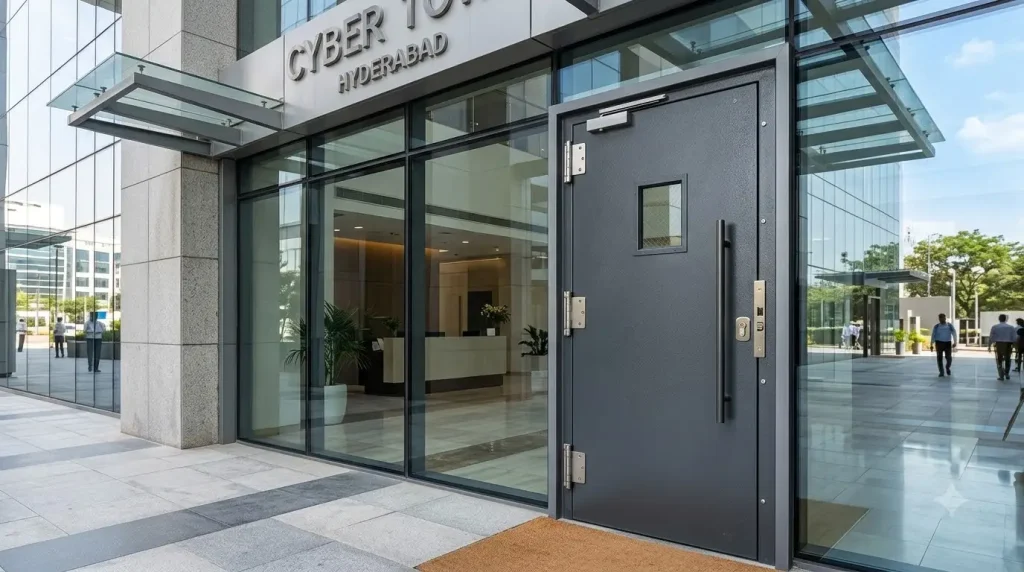
Metal Doors Manufacturers in Hyderabad What to Check Before You Place an Order

A metal door looks simple until it fails. A hinge that sags after six months. A powder coat that peels in the monsoon. A fire-rated door that was never actually tested for fire rating. If you’ve spent any time comparing metal doors manufacturers in Hyderabad, you’ve probably noticed that most quotations look identical on paper — same gauge, same finish, same price band — right up until the doors arrive on site.

This piece is written for people who don’t want to learn that lesson the expensive way: builders sourcing for an apartment project in Gachibowli, a factory owner in Patancheru fitting out a new unit, a hospital administrator in Kondapur who needs doors that meet fire safety norms, or a homeowner in Kukatpally replacing a rusted main door before the next rains hit. We’ll walk through what actually separates a dependable manufacturer from one that just owns a welding shop.

Why Hyderabad Businesses Are Rethinking Their Door Choices

Hyderabad’s construction boom hasn’t slowed — IT corridors, warehousing hubs along the Outer Ring Road, and residential towers in Kokapet are all pushing demand for doors that do more than close a gap in a wall. Builders now ask for doors that resist humidity, deter break-ins, and pass fire audits, sometimes all three at once.

That shift matters because wood is losing ground fast. Termites, warping, and rising timber costs have pushed architects and facility managers toward steel and galvanized doors for entrances, service areas, and utility rooms. The catch: not every fabricator who can weld a frame can deliver a door that holds its shape, seals properly, and survives daily use for a decade.

The Gap Between "Fabricator" and "Manufacturer"

There’s a real difference between a roadside welding unit and an actual manufacturing setup. A proper manufacturer works from engineered drawings, uses calibrated sheet-cutting equipment, and runs quality checks on thickness, weld strength, and finish consistency. A fabricator, on the other hand, often builds by eye. Both can quote similar prices. Only one gives you a door that performs the same way in year five as it did on day one.

What to Actually Evaluate When Comparing Metal Door Suppliers

Most buyers compare price first and specifications second. Flip that order, and the price comparison becomes far more meaningful.

1. Sheet Gauge and Steel Grade

Ask for the exact gauge (thickness) in mm, not just “heavy duty” as a description. Commercial and security doors typically need 1.2mm to 2mm cold-rolled or galvanized steel, depending on the application. Thinner sheets flex, dent, and dampen the sound of a solid door within a year.

2. Core Material

A hollow steel door and a door with a honeycomb or rigid foam core behave very differently under impact, heat, and sound transfer. For fire-rated applications, the core material is what actually earns the rating — the outer steel skin alone does not.

3. Certifications That Are Verifiable

Fire-rated doors should carry test certificates from a recognized testing agency, not just a manufacturer’s claim. For institutional projects — hospitals, schools, IT parks — ask to see the actual certificate and confirm the door specification matches what was tested, not a similar-looking model.

4. Hinge and Hardware Quality

Doors rarely fail at the panel. They fail at the hinges, the locking mechanism, or the frame anchoring. A manufacturer worth hiring will specify hinge load ratings and use hardware rated for the door’s weight and usage frequency.

5. Finish and Corrosion Protection

Hyderabad’s summers are harsh on exposed metal, and humidity during the monsoon accelerates corrosion on poorly coated surfaces. Ask whether the finish is electrostatic powder coating, and whether a rust-primer layer is applied before painting. This single detail decides whether a door looks new after five years or rusted after one monsoon.

6. Site Measurement Before Fabrication

Manufacturers who quote from a phone call and fabricate without a site visit are gambling with your installation. Frame misalignment by even a few millimeters causes doors to stick, gap, or fail to latch. Insist on a physical site measurement before production begins.

Enhancing Indoor Comfort Throughout the Year

Choosing a manufacturer with proper production capability, rather than a one-person welding outfit, pays off in ways that aren’t obvious at the quotation stage.

  • Consistency across bulk orders — a 40-flat residential project needs every door to match in fit and finish, not “close enough.”
  • Documented warranties — a real manufacturer stands behind hinge failure, coating defects, or frame issues in writing.
  • Faster turnaround on repeat orders — once your specifications are on file, reorders don’t require re-explaining everything.
  • Compliance support — for fire doors and security doors, a proper manufacturer helps you assemble the paperwork auditors ask for.
  • On-site troubleshooting — misaligned frames or hardware issues get fixed by someone who understands the original fabrication, not a random handyman.

Why Choose Buildwick for Metal Doors in Hyderabad

Buildwick has built its reputation on doors that are engineered before they’re welded. Every order starts with an actual site visit and measurement, not a phone-quoted estimate, which is why fit issues at installation are rare rather than routine.

The production process uses calibrated sheet-cutting and consistent gauge steel across every unit in a batch, so a bulk order for a residential tower or a commercial complex arrives uniform — no visible variation from door to door. For fire-rated and security applications, doors are built to match tested specifications, not approximated to look similar.

Clients across Hyderabad — from builders in Kompally to facility teams managing warehouses near Shamshabad — return for repeat orders because the specification stays consistent between the first door and the five-hundredth. That reliability, more than any single feature, is what keeps a metal door manufacturer in business for the long term.

Latest Industry Trends in Metal Door Manufacturing

The metal door business in Hyderabad is shifting in a few clear directions.

  • Thermal-break steel doors are gaining ground in commercial buildings that want steel’s strength without the heat transfer, especially for IT campuses running heavy air conditioning loads.
  • Digital locking integration is now a standard request, not a premium add-on. Manufacturers who can pre-drill and reinforce doors for smart locks are getting preferred vendor status on new projects.
  • Acoustic-rated doors are increasingly specified for conference rooms, hospitals, and studios, driven by demand from the IT and healthcare sectors expanding around HITEC City and Gachibowli.
  • Recyclable and low-VOC coatings are showing up in tenders from clients pursuing green building certifications.
  • Modular frame systems that speed up installation are replacing older welded-in-place frame methods, cutting site labor time significantly.

Manufacturers who haven’t adapted to these shifts are increasingly losing bids to those who have — worth checking where a prospective vendor stands before committing to a large order.

Common Mistakes Businesses Make When Sourcing Metal Doors

  • Comparing quotes without matching specifications — a “heavy duty steel door” from one vendor and another can differ by 0.5mm gauge, which changes the price and the durability dramatically.
  • Skipping the fire certificate check — buyers often accept a verbal assurance instead of asking for the actual test document, which becomes a serious problem during a fire safety audit.
  • Ignoring hardware specifications — focusing entirely on the steel panel while the hinges and locks, which fail first, get no attention at all.
  • Ordering without a site visit — leading to frames that don’t fit and delays that push back entire project timelines.
  • Choosing the lowest bid without checking after-sales support — a cheap door with no warranty backup often costs more once repair and replacement are factored in.

Expert Tips Before You Finalize a Manufacturer

  • Ask for two or three reference sites where the manufacturer has delivered similar doors, and actually visit one if the order is large.
  • Request a sample panel before committing to a bulk order — a physical sample reveals gauge, weld quality, and finish far better than a spec sheet.
  • Get the warranty terms in writing, including what’s covered for hinges, locks, and coating separately.
  • Confirm the delivery and installation timeline in the contract, not just a verbal estimate — site delays are common when this isn’t documented.
  • For fire-rated or security doors, insist on certificate copies matching the exact door model, not a general company certification.

Questions

Pricing depends on gauge, core material, size, and finish. Basic steel doors for residential use typically cost less than fire-rated or acoustic doors built for commercial and institutional projects. It's best to get a quote based on your exact specification rather than a general price range.
Standard orders usually take one to three weeks depending on quantity and design complexity, with installation adding a few more days for larger commercial projects. Site measurement is done first, followed by fabrication and delivery.
Fire safety norms for commercial, healthcare, and high-occupancy buildings generally require fire-rated doors in specific locations such as stairwells and utility rooms. Requirements vary by building type and occupancy, so it's worth confirming with your project's fire safety consultant.
Galvanized steel has a zinc coating that resists corrosion better, making it suited for exposed or high-humidity locations. Cold-rolled steel is often used indoors where corrosion exposure is lower and cost efficiency matters more.
Yes. A proper manufacturer can fabricate doors to custom dimensions, panel designs, and hardware configurations, which is common for heritage-style buildings, unusual door openings, or branded commercial entrances.
Ask for the actual test certificate from the testing agency and cross-check that the door specification (thickness, core, size) matches what was tested. A verbal assurance alone isn't sufficient for compliance purposes.
Most manufacturers offer volume-based pricing for bulk orders, particularly for standardized sizes used across multiple units in an apartment complex or office building. It's worth discussing project scale upfront to lock in better terms.

Conclusion

Metal doors are one of those purchases that quietly separates a well-run project from a problematic one. The specifications that matter — steel gauge, core material, hinge rating, corrosion protection, and genuine certification — rarely show up in a one-line quotation, which is exactly why so many buyers get stuck with doors that underperform. Asking the right questions before production starts costs nothing and saves considerably more than the price difference between two quotes ever could.

Strong Call-to-Action

If you’re comparing metal door manufacturers in Hyderabad for an upcoming project, talk to the Buildwick team before you finalize a vendor. Share your site details and requirements, and we’ll walk you through gauge, certification, and pricing specifics so you’re comparing like for like — not just numbers on a page. Get in touch for a site visit and a detailed quotation.