Industrial Fire Doors in Hyderabad What 2026's Compliance Push Means for Your Facility

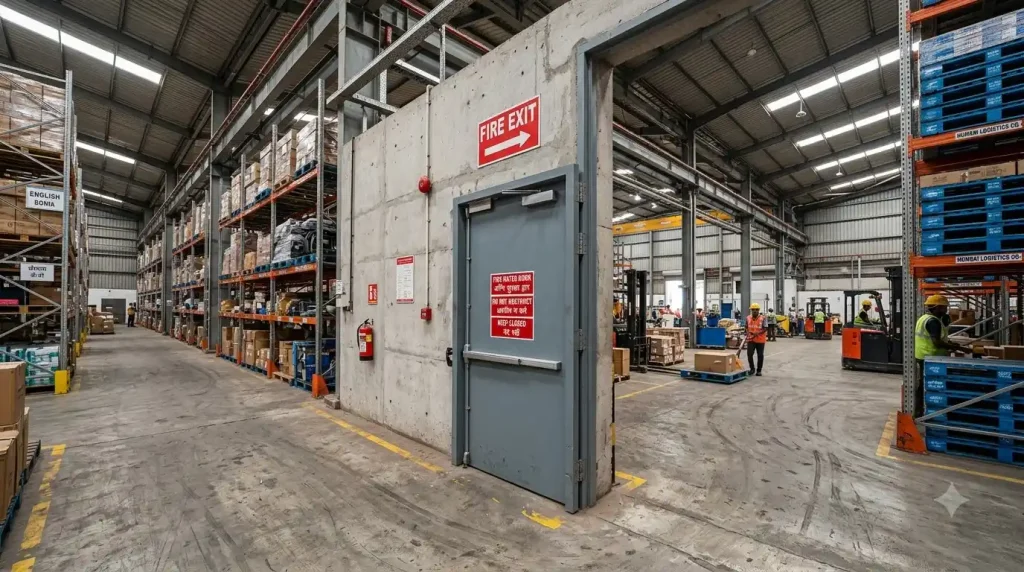
Industrial fire doors in Hyderabad fire compartmentation warehouse facility

Industrial fire safety in India has moved from a background compliance item to a front-page concern. Between January and April 2026 alone, six major industrial disasters across power, steel, mining, and chemical facilities caused dozens of deaths and injuries nationwide, and Telangana’s own industrial corridor hasn’t been an exception — a 2025 dust explosion at a Pashamylaram chemical facility was among the deadliest single industrial incidents in recent Indian history. Industry reviews of these incidents keep surfacing the same pattern: expired licenses, missing fire NOCs, and equipment that was installed but non-functional at the time of the event.

That pattern is exactly why industrial fire doors in Hyderabad are getting more scrutiny in 2026 than they have in years. Fire compartmentation — the strategy of dividing a facility into fire-resistant zones using rated walls and doors — is one of the few measures that actively buys evacuation time and limits damage spread when other systems fail. This guide covers what industrial facilities in Hyderabad actually need from fire door compartmentation, what’s changed in enforcement, and how to specify correctly for a factory, warehouse, or chemical storage environment.

Why Industrial Fire Doors Are Getting More Attention in 2026

Hyderabad’s construction boom hasn’t slowed — IT corridors, warehousing hubs along the Outer Ring Road, and residential towers in Kokapet are all pushing demand for doors that do more than close a gap in a wall.

A few converging factors are driving this shift:

  • Regulatory enforcement is tightening. Facility audits are increasingly checking installed fire door assemblies against certification documentation, not just confirming a door is present.
  • Hyderabad’s warehousing footprint is growing fast, driven by e-commerce and logistics expansion along the Patancheru, Pashamylaram, and Shamshabad corridors, which means more large-footprint storage facilities need proper compartmentation from the design stage.
  • Combustible dust and chemical storage risks are getting specific attention following recent incidents, since generic fire safety measures often don’t address dust explosion or chemical fire hazards adequately.
  • Insurance and compliance are increasingly linked, with some insurers offering better terms for facilities that can demonstrate certified fire safety measures, adding a financial incentive alongside the regulatory one.

Builders now ask for doors that resist humidity, deter break-ins, and pass fire audits, sometimes all three at once.

That shift matters because wood is losing ground fast. Termites, warping, and rising timber costs have pushed architects and facility managers toward steel and galvanized doors for entrances, service areas, and utility rooms. The catch: not every fabricator who can weld a frame can deliver a door that holds its shape, seals properly, and survives daily use for a decade.

How Fire Compartmentation Works in Industrial Facilities

Fire compartmentation divides a large industrial space into smaller zones using fire-rated walls and doors, so a fire starting in one section doesn’t spread unchecked across an entire factory or warehouse floor. This is particularly important in industrial settings because:

  • Large open floor plates in warehouses allow fire to spread faster than in compartmentalized commercial buildings
  • High storage density and combustible materials increase both fire load and spread speed
  • Hazardous material storage and hot work areas (welding, cutting, grinding) create ignition risks that need physical containment strategies, not just detection systems

Industrial fire doors are the access points within this compartmentation strategy — every rated wall needs a correspondingly rated door where personnel or equipment need to pass through.

What Industrial Fire Doors Need Beyond Standard Fire-Rated Doors

Industrial applications carry requirements that go beyond a standard commercial fire door specification:

Higher Cycle Tolerance

Industrial fire doors often sit on routes with more frequent personnel and equipment movement than a commercial stairwell door, so hardware needs to hold its certified performance despite more daily use.

Chemical and Dust Environment Compatibility

Facilities handling chemicals or combustible dust need fire doors and seals rated for that specific hazard category, since generic fire-rated assemblies aren’t necessarily tested against chemical exposure or dust ignition scenarios.

Hot Work Area Compartmentation

Designated welding, cutting, and grinding areas benefit from fire door separation from the rest of the facility, containing sparks and ignition risk to a controlled zone.

PEB Warehouse Integration

Pre-engineered building (PEB) warehouses need fire compartmentation planned into the design stage, with fire-rated walls dividing large open spans into smaller sections and doors sized correctly for the compartmentation plan.

What to Check Before Ordering Industrial Fire Doors in Hyderabad

  • Assembly test certification covering leaf, frame, and hardware together, not the leaf alone
  • Rating duration appropriate to the hazard category — chemical and dust environments may need different specifications than general storage
  • Compatibility with your facility’s Fire NOC requirements, since a mismatch between installed doors and your registered fire safety plan is a documented cause of compliance failures
  • Installation tolerance guidance, since even a certified assembly loses its rating if installed with incorrect gaps or incompatible hardware
  • Manufacturer’s local project history, particularly with industrial and warehouse facilities in Hyderabad’s specific industrial zones

Buildwick Fire Rated Doors for Industrial Facilities in Hyderabad

Buildwick manufactures fire rated doors at its Hyderabad and Dindigul facilities, supplying certified assemblies for commercial, institutional, and industrial applications. The company is ISO 9001:2015 and ISO 3614 certified, with over 4,000 completed projects and an 80% repeat and referral client base.

For factories and warehouses across Hyderabad’s industrial corridors, Buildwick’s fire door range works alongside industrial shutters and general doors to support full facility compartmentation planning, with local manufacturing support for installation guidance specific to Hyderabad’s regulatory environment.

Common Mistakes Industrial Facilities Make

The metal door business in Hyderabad is shifting in a few clear directions.
  • Thermal-break steel doors are gaining ground in commercial buildings that want steel’s strength without the heat transfer, especially for IT campuses running heavy air conditioning loads.
  • Digital locking integration is now a standard request, not a premium add-on. Manufacturers who can pre-drill and reinforce doors for smart locks are getting preferred vendor status on new projects.
  • Acoustic-rated doors are increasingly specified for conference rooms, hospitals, and studios, driven by demand from the IT and healthcare sectors expanding around HITEC City and Gachibowli.
  • Recyclable and low-VOC coatings are showing up in tenders from clients pursuing green building certifications.
  • Modular frame systems that speed up installation are replacing older welded-in-place frame methods, cutting site labor time significantly.
Manufacturers who haven’t adapted to these shifts are increasingly losing bids to those who have — worth checking where a prospective vendor stands before committing to a large order.

Expert Tips for Industrial Facility Managers

  • Build fire door inspection into your facility’s existing maintenance schedule rather than treating it as a separate, easily forgotten task.
  • For chemical or combustible dust environments, request hazard-specific fire door specifications rather than a generic commercial-grade fire door.
  • Keep Fire NOC documentation current and cross-check it against your actual installed fire door assemblies periodically.
  • Plan compartmentation zones during the design stage for any new PEB warehouse construction, since retrofitting compartmentation into an existing large-span structure is significantly more disruptive and costly.
  • Work with a manufacturer who can speak specifically to industrial and hazardous-environment fire door requirements, not just standard commercial applications.

Questions

Fire compartmentation divides a facility into fire-resistant zones using rated walls and doors, containing a fire to one section instead of letting it spread across an entire factory or warehouse floor.
Often yes, particularly for chemical or combustible dust environments, which need hazard-specific ratings and seals beyond a standard commercial fire door assembly.
Your installed fire door assemblies need to match what's documented in your facility's Fire NOC and safety plan; a mismatch is a commonly cited cause of compliance failures during audits.
Fire compartmentation, including fire-rated doors at zone boundaries, is a recommended and increasingly enforced design feature for PEB warehouse buildings in India.
Yes. Buildwick manufactures certified fire rated doors at its Hyderabad and Dindigul facilities, supplying commercial, institutional, and industrial applications.
Fire doors should be part of a facility's regular maintenance and compliance schedule, with periodic inspection to confirm the installed assembly still performs as certified.

Contact Buildwick at +91 98483 12000 or enquiry@buildwick.net, or use the contact page to discuss your facility's compartmentation and compliance requirements.

Conclusion

Industrial fire doors in Hyderabad are no longer a checkbox item on a construction punch list — they’re a core part of how a factory or warehouse actually limits damage and protects lives when something goes wrong. With enforcement tightening and Telangana’s own industrial corridor having seen the real cost of compliance gaps firsthand, facility managers and project teams have a clear incentive to get compartmentation right from the design stage rather than retrofitting after an audit flags a problem. Certified assemblies, hazard-specific specifications, and an ongoing inspection schedule are what separate a facility that’s genuinely protected from one that’s only technically compliant on paper.

Strong Call-to-Action

Planning fire compartmentation for an industrial facility in Hyderabad? Contact Buildwick at +91 98483 12000 for certified fire door specifications suited to your facility’s hazard profile.