
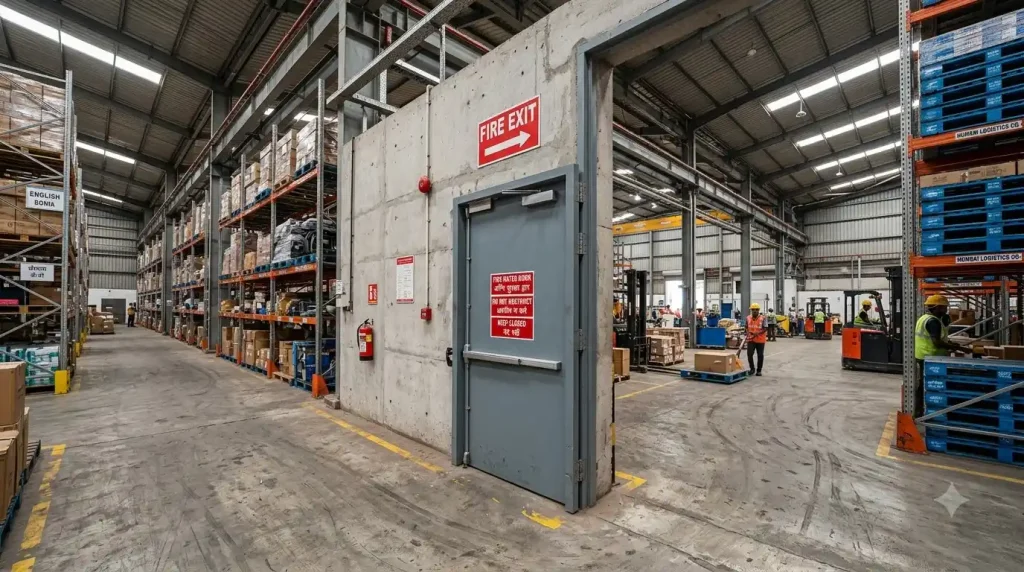
Industrial fire safety in India has moved from a background compliance item to a front-page concern. Between January and April 2026 alone, six major industrial disasters across power, steel, mining, and chemical facilities caused dozens of deaths and injuries nationwide, and Telangana’s own industrial corridor hasn’t been an exception — a 2025 dust explosion at a Pashamylaram chemical facility was among the deadliest single industrial incidents in recent Indian history. Industry reviews of these incidents keep surfacing the same pattern: expired licenses, missing fire NOCs, and equipment that was installed but non-functional at the time of the event.
That pattern is exactly why industrial fire doors in Hyderabad are getting more scrutiny in 2026 than they have in years. Fire compartmentation — the strategy of dividing a facility into fire-resistant zones using rated walls and doors — is one of the few measures that actively buys evacuation time and limits damage spread when other systems fail. This guide covers what industrial facilities in Hyderabad actually need from fire door compartmentation, what’s changed in enforcement, and how to specify correctly for a factory, warehouse, or chemical storage environment.
Hyderabad’s construction boom hasn’t slowed — IT corridors, warehousing hubs along the Outer Ring Road, and residential towers in Kokapet are all pushing demand for doors that do more than close a gap in a wall.
A few converging factors are driving this shift:
Builders now ask for doors that resist humidity, deter break-ins, and pass fire audits, sometimes all three at once.
That shift matters because wood is losing ground fast. Termites, warping, and rising timber costs have pushed architects and facility managers toward steel and galvanized doors for entrances, service areas, and utility rooms. The catch: not every fabricator who can weld a frame can deliver a door that holds its shape, seals properly, and survives daily use for a decade.
Fire compartmentation divides a large industrial space into smaller zones using fire-rated walls and doors, so a fire starting in one section doesn’t spread unchecked across an entire factory or warehouse floor. This is particularly important in industrial settings because:
Industrial fire doors are the access points within this compartmentation strategy — every rated wall needs a correspondingly rated door where personnel or equipment need to pass through.
Buildwick manufactures fire rated doors at its Hyderabad and Dindigul facilities, supplying certified assemblies for commercial, institutional, and industrial applications. The company is ISO 9001:2015 and ISO 3614 certified, with over 4,000 completed projects and an 80% repeat and referral client base.
For factories and warehouses across Hyderabad’s industrial corridors, Buildwick’s fire door range works alongside industrial shutters and general doors to support full facility compartmentation planning, with local manufacturing support for installation guidance specific to Hyderabad’s regulatory environment.
Contact Buildwick at +91 98483 12000 or enquiry@buildwick.net, or use the contact page to discuss your facility's compartmentation and compliance requirements.
Planning fire compartmentation for an industrial facility in Hyderabad? Contact Buildwick at +91 98483 12000 for certified fire door specifications suited to your facility’s hazard profile.


© 2026 Buildwick. All Rights Reserved.
