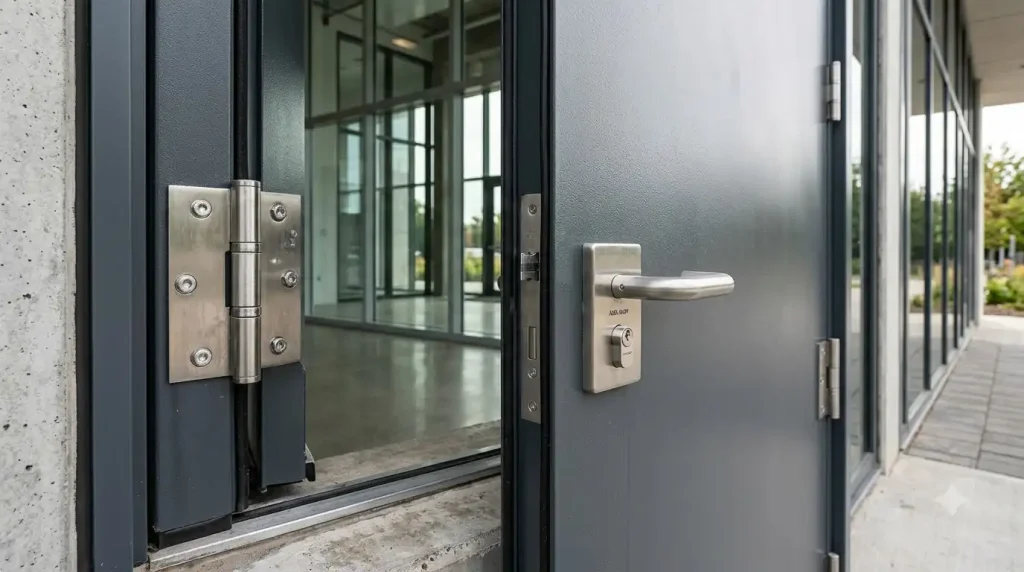
Steel Doors Buying Guide: How to Specify the Right Door for Your Project

Galvanized steel doors manufactured by Buildwick for commercial and industrial buildings

Most door failures on a construction site don’t happen because the material was wrong. They happen because nobody checked the specification before placing the order. A 22-gauge frame gets used where a 16-gauge fire-rated leaf was needed. A scientific lab gets a general-purpose door with the wrong hardware clearance. By the time anyone notices, the doors are installed, the contractor has moved to the next floor, and fixing it means tearing out finished work.

Steel doors solve more problems than almost any other building material — security, fire compliance, weather resistance, low maintenance — but only when they’re specified correctly for the application. This guide walks through exactly what to check before you finalize an order: gauge thickness, core construction, fire ratings, hardware compatibility, and the cost factors that actually move the price up or down. If you’re an architect writing a specification, a contractor sourcing for a live project, or a facility owner replacing doors that failed early, this is the reference to work from.

Why Steel Doors Are the Default Choice for Serious Construction

Timber warps. Aluminium dents. uPVC softens under direct sun exposure over years. Steel doors don’t have those failure modes, which is why they’ve become the standard specification for commercial, industrial, and institutional projects across India.

The core advantages come down to four things:

  • Structural strength — a properly gauged steel door resists forced entry, impact, and daily heavy use far better than timber or composite alternatives.
  • Fire performance — steel doors can be manufactured and certified to resist fire and smoke for defined durations, which timber and most composite doors cannot match without extensive treatment.
  • Weather and pest resistance — steel doesn’t absorb moisture, doesn’t attract termites, and holds its shape through Indian summers and monsoons without swelling or cracking.
  • Low lifetime cost — a powder-coated, galvanized steel door needs almost no repainting or repair over its service life, which changes the total cost of ownership even when the upfront price is higher than timber.

None of that means every steel door is interchangeable. The specification inside that four-point list is where projects succeed or run into rework.

Understanding Steel Door Gauge Thickness

Gauge thickness is the first thing to lock down, and it’s the specification most frequently skipped or guessed at.

Steel door leaves and frames are made from cold-rolled or galvanized steel sheet, measured in gauge — the lower the number, the thicker the steel. Common ranges used in Indian construction:

  • 20–22 gauge — suitable for lighter interior applications, cabin doors, and low-traffic residential use.
  • 18 gauge — the common standard for most commercial doors, balancing strength and cost.
  • 16 gauge — used where higher security, heavier daily traffic, or fire rating requirements apply, such as main entrances, industrial access points, and fire-rated assemblies.

Frames are typically specified one or two gauges heavier than the leaf, since the frame carries the hinge load and takes the most repeated stress over the door’s life. If your specification only states “steel door” without a gauge, you’re leaving the decision to whoever quotes cheapest — and that’s usually where the wrong-gauge problem starts.

Core Construction: What's Actually Inside the Door

The steel skin is only half the specification. What fills the cavity between the two steel faces determines fire performance, sound insulation, and weight.

  • Honeycomb kraft paper core — lightweight, cost-effective, adequate for standard interior and low-fire-risk doors.
  • Mineral wool or rock wool core — used in fire-rated steel doors, since the core needs to resist heat transfer and maintain structural integrity during a fire event.
  • Polyurethane foam core — offers better thermal and acoustic insulation, often specified for doors separating conditioned and unconditioned spaces.

If a project brief calls for fire-rated steel doors and the quote doesn’t specify the core material, ask before signing off. A door with the correct steel gauge but the wrong core will not hold its fire rating, no matter how it looks on delivery.

Fire Rating: What the Numbers Actually Mean

Fire-rated steel doors are tested and rated for how long they contain fire and smoke — commonly expressed in ratings up to 120 minutes for commercial and industrial applications. This matters most for:

  • Stairwell and shaft enclosures
  • Compartmentation between building zones
  • Escape routes and emergency egress points
  • Server rooms, electrical rooms, and high-risk storage

A door only qualifies as fire-rated as an assembly — leaf, frame, hinges, closer, and seals tested together. Swapping a certified fire door leaf onto an unrated frame, or fitting standard hardware, breaks the rating even if the leaf itself is correctly manufactured. This is one of the most common site-level mistakes on commercial projects, and it’s worth checking explicitly with your supplier when specifying fire rated doors for any life-safety application.

Steel Doors for Different Building Types

Not every project needs the same specification. Here’s how the requirement typically shifts by building type:

Warehouses and factories — high-traffic, heavy-duty steel doors with reinforced frames and hardware rated for repeated daily operation. Security and impact resistance matter more than acoustic performance here.

Hospitals and laboratories — hygiene-focused specifications, smooth non-porous finishes that resist bacterial growth, and precise clearances for controlled environments. Buildwick’s scientific door range is built specifically for this requirement.

Educational institutions — a mix of fire compliance for corridors and stairwells, plus durable general-purpose doors for classrooms that need to withstand years of daily student traffic.

Commercial offices and retail — aesthetics matter alongside function, so powder-coated finishes and clean sightlines are usually specified alongside standard security requirements.

Residential and apartment projects — a lighter-duty but still secure specification, often paired with residential doors for entry points that need both a finished look and daily reliability.

Utility and service shafts — plumbing, electrical, and fire safety shaft applications call for a narrower, purpose-built category. Shaft doors are designed around these access and fire-separation requirements specifically.

Benefits of Getting the Steel Doors Specification Right

When steel doors are specified correctly for the application, the payoff shows up over years, not just at handover:

  • No early replacement cost from under-specified gauge or core
  • Fire compliance holds up during inspection and certification renewals
  • Lower maintenance calls — no repainting, no warping, no hardware failure from mismatched loads
  • Consistent appearance across a multi-building or multi-floor project
  • Easier facility management, since one specification standard applies across similar door types

Why Choose Buildwick

Buildwick has been manufacturing doors and windows since 2017, with production facilities serving projects across Hyderabad, Telangana, Bangalore, Chennai, Mumbai, Pune, and Delhi NCR. The company is ISO 9001:2015 and ISO 3614 certified, and has delivered over 4,000 projects across more than 10 industries.

What that means for a specification-driven buyer: every steel door leaving the facility is built to the gauge, core, and finish stated on the order — not adjusted quietly to protect margin. Buildwick’s commercial doors range covers fire-rated, scientific, general-purpose, and shaft door categories, so architects and contractors can source multiple door types from one specification-compliant supplier rather than reconciling parts from different vendors. For projects that also need industrial shutters or window systems alongside steel doors, working with a single manufacturer simplifies procurement and keeps finish and hardware consistent across the building.

Latest Industry Trends in Steel Doors

A few shifts are worth factoring into current specifications:

  • Higher demand for certified fire compliance — with stricter enforcement of fire safety norms in commercial and institutional buildings, buyers are asking for test certificates upfront rather than after installation.
  • CNC-precision manufacturing — tighter tolerances mean fewer on-site adjustments and better long-term sealing performance, particularly for fire and acoustic doors.
  • Custom sizing over standard catalog sizes — more architects are specifying non-standard openings for design reasons, which requires a manufacturer capable of custom fabrication rather than stock sizes only.
  • Powder coating over conventional paint — powder-coated finishes are becoming the default for steel doors because they resist chipping and UV fade far longer than painted finishes, reducing repainting cycles.

Common Mistakes Buyers Make When Ordering Steel Doors

  • Specifying “steel door” without gauge or core details, leaving the vendor to fill in the gap with whatever is cheapest to supply.
  • Assuming a fire-rated leaf alone meets code, without confirming the frame, hardware, and seals are part of the same tested assembly.
  • Skipping site measurement before ordering, which leads to on-site cutting that compromises both structural integrity and fire performance.
  • Choosing based on upfront price alone, without accounting for maintenance-free lifetime cost, which usually favors steel doors over timber or composite alternatives.
  • Not confirming ISO or IS code compliance documentation before installation, which becomes a problem later during fire safety audits or building certifications.

Expert Tips for Specifying Steel Doors

  • Always request the gauge thickness and core material in writing on the quotation, not just the finish and size.
  • For any fire-rated requirement, ask for the assembly test certificate — covering the leaf, frame, and hardware together — not just the leaf specification.
  • Match hardware load ratings to expected daily traffic; a door rated for 50 cycles a day will fail early in a 500-cycle warehouse application.
  • Get site measurements taken by the manufacturer or an authorized installer rather than relying on architectural drawings alone, since site conditions often shift during construction.
  • For multi-building projects, standardize on one gauge and finish specification across similar door types to simplify future maintenance and replacement.

Questions

18-gauge is the common standard for most commercial applications, while 16-gauge is used where higher security or fire rating is required, such as main entrances and industrial access points.
A properly specified, powder-coated steel door typically outlasts a timber door by a significant margin, since it doesn't warp, swell, or attract termites. Maintenance needs are also considerably lower over the door's lifetime.
Yes, when manufactured and certified as a complete assembly — leaf, frame, and hardware tested together for a specific fire rating duration. A steel leaf alone without a matching certified frame does not meet compliance
Warranty terms vary by manufacturer and application; Buildwick provides warranty coverage aligned with the specific door category and usage conditions, confirmed at the time of quotation.
Powder-coated galvanized steel doors need minimal maintenance — occasional cleaning and periodic hardware checks are usually sufficient, with no repainting required under normal conditions.
Yes, CNC-precision manufacturing allows custom sizing for non-standard architectural openings, which is increasingly common in modern commercial and residential design.
Both. Lighter-gauge steel doors with residential finishes work well for home entry points, while heavier-gauge doors are used for commercial and industrial applications with higher security or fire requirements.

Conclusion

Getting steel doors right on paper before they’re manufactured saves far more time and cost than fixing a wrong specification after installation. Gauge thickness, core material, and fire-rated assembly compliance aren’t details to leave to a vendor’s default — they’re the decisions that determine whether the door performs for the next fifteen years or needs replacing in three. Whether you’re specifying for a warehouse, a hospital corridor, or a home entrance, start with the application requirement and work backward to the specification, not the other way around.

Strong CTA

Planning a project that needs correctly specified steel doors? Talk to Buildwick’s team for a specification review and quote—gauge, core, fire rating, and finish confirmed in writing before manufacturing begins.